
Most people picture a kill cord on an outboard: a red lanyard clipped to a switch by the throttle. Plenty of fishing boats, workboats and cruisers run inboard diesels instead, and the good news is that a wireless kill switch can stop those too. It just needs to be connected the right way.
This guide explains how OLAS Guardian works with a diesel, what you need to check before you order, and how to test it once it's fitted.
How a diesel is stopped
A petrol outboard stops when its ignition is cut. A diesel has no spark, so it's stopped by cutting its fuel or air, usually with an electric stop solenoid. That solenoid is controlled in one of three ways:
- Directly: the stop switch powers the stop solenoid itself.
- Through a stop relay: the stop switch operates a relay, and the relay powers the solenoid.
- Through the engine ECU: on electronic engines, the stop switch sends a signal to the engine computer.
Engines stopped by a mechanical stop lever or pull cable, with no electrics, can't currently be used with Guardian.
Open to stop or close to stop?
The next question is what the stop circuit needs to do to stop the engine:
- Close to stop (normally open): the engine stops when the circuit is completed. Guardian connects in parallel with your existing stop switch.
- Open to stop (normally closed): the engine stops when the circuit is broken. The existing stop cable is cut and Guardian connects in series.
Guardian has a wire for each: grey is common, brown is close to stop and purple is open to stop. You connect grey and one of the other two, never both, and cap the unused wire.
The 2 amp rule: do you need a relay box?
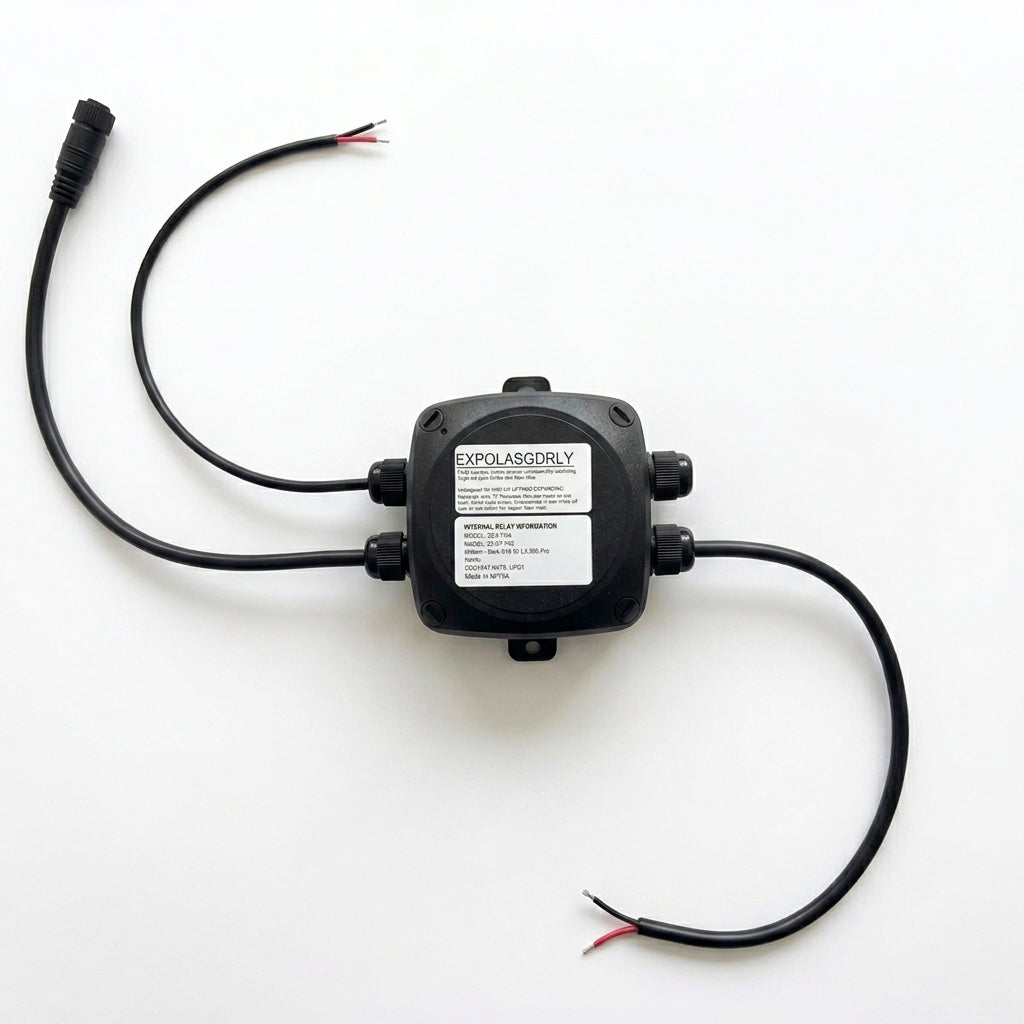
Guardian's internal relay can switch stop circuits of up to 2 A. That covers outboards and many diesels where the stop switch operates a stop relay. If your stop switch powers a solenoid directly, the current is usually higher, and you'll need the OLAS diesel relay box between Guardian and the engine.
- Diesel Engine Stop Relay Box (Single Engine) for one engine.
- Diesel Engine Stop Relay Box (Twin Engine) for two engines. Twin installs generally use the relay box.
The relay box uses a 30 A relay in an IP66 enclosure. When it's fitted, Guardian is powered through the relay box's connection cable, so the hub doesn't need its own power feed. Relay boxes are built to order, with a standard lead time of about one month, so order well before you plan to fit it.
Not sure what you've got?
The OLAS Guardian installation guide has a system checker. Answer five questions (engine type, number of engines, how the stop switch works, open or close to stop, and supply voltage) and it shows the parts you need and the wiring diagram for your boat. If you still can't tell, contact us with your engine make and model and we'll help.
Things to know before you fit it
- Get it fitted properly. Installation by a qualified marine electrician or engineer is recommended, following the engine manufacturer's instructions. A diesel install with a relay box can take up to half a day.
- Power: Guardian runs on 10–32 V DC. Fit a 2 A inline fuse on the positive feed, after the battery isolator.
- Smart Lock: Guardian's engine immobiliser is for outboards only. Don't use Smart Lock on inboard diesel or Volvo Penta engines.
- Using N2K on a diesel? OLAS N2K does everything Guardian does and adds the overboard position to your chart plotter. Contact us about inboard diesel installs.
Test it in the water
Once it's fitted, check the control switch is green, run the engine at idle in neutral, and put a tag into at least 10 cm of open water for two seconds or more. The engine should stop. On a twin install, check that both engines stop. Repeat with every tag. Our guide to testing your kill switch and overboard alarm explains why a bucket of water isn't a real test.
Find out more
See the engine kill switch range, or Guardian for working boats for fishing and commercial installs. For step-by-step wiring, use the installation guide.
OLAS Guardian is an aid to, not a replacement for, standard MOB procedures and safety equipment. It does not give instantaneous protection if the operator falls into the path of the vessel.